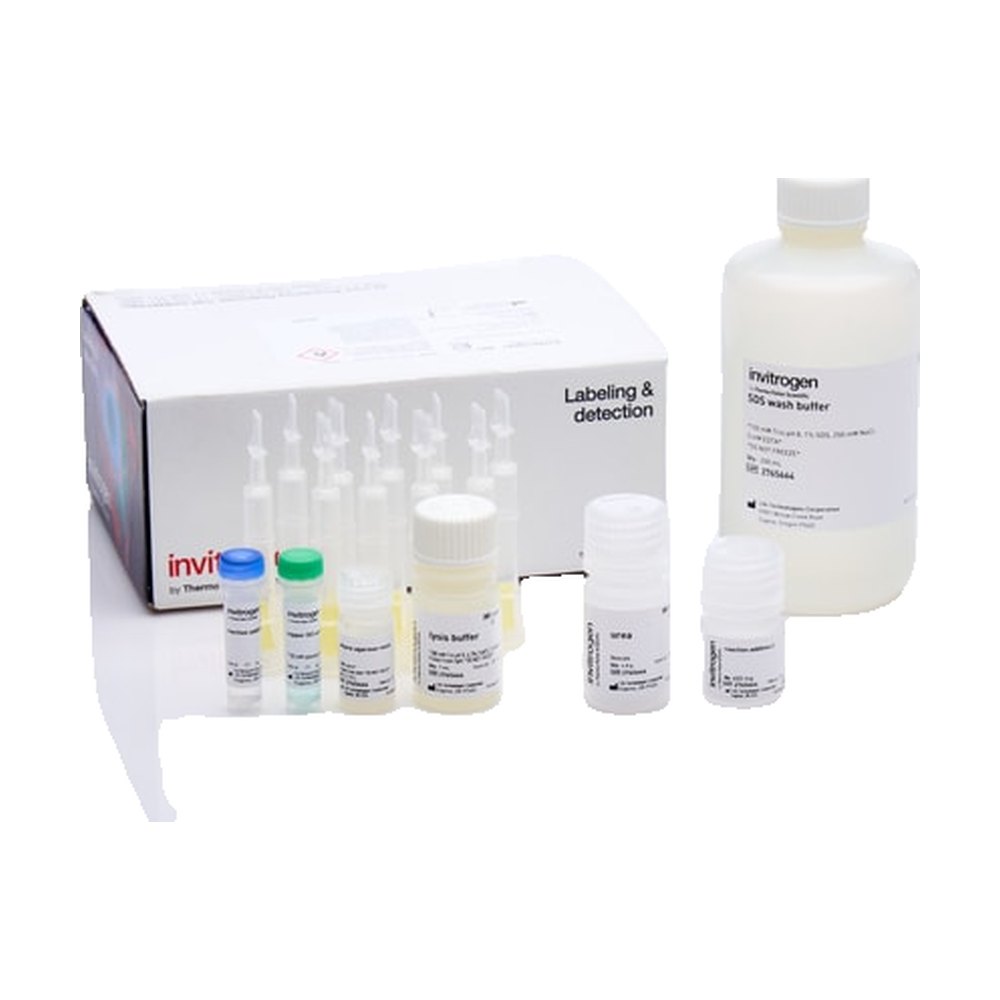
Elevate biopharmaceutical research with pHrodo Antibody Labeling kits, designed to characterize antibody internalization, a critical step during antibody-drug conjugate research and development. Kits provide a simple, detailed protocol and advanced…
Elevate biopharmaceutical research with pHrodo Antibody Labeling kits, designed to characterize antibody internalization, a critical step during antibody-drug conjugate research and development. Kits provide a simple, detailed protocol and advanced purification columns to easily label and purify antibodies and other large proteins. Amine-reactive pHrodo dyes covalently bind to antibodies and other proteins to produce bright, soluble conjugates whose fluorescence increases in acidic organelles including endosomes and lysosomes. Antibody internalization can be evaluated using flow cytometry, fluorescence microscopy, and high-content screening.
The microscale protein labeling kit pHrodo iFL Red and pHrodo iFL Green provide the reagents necessary to easily mark three samples of antibodies or proteins purified on a small scale (20 to 100 µg) with pHrodo iFL Red or pHrodo iFL Green dye. These kits contain STP dester dye pHrodo iFL Red or Green pH sensitive and l-reactive that covalently binds to free lysins wherever they are found in an antibody or protein.
The pHrodo iFL Red and pHrodo iFL Green dyes are improved versions of the pHrodo Red and pHrodo Green dyes and optimized for the creation of soluble and sharp bioconjugates for use in the study of the internalization of antibodies, løndocytosis and phagocytosis. They are also more soluble than the original pHrodo Red and pHrodo Green dyes, making them useful for marking antibodies that can otherwise rush outside the solution during conjugation. The pHrodo iFL Red and pHrodo iFL Green dyes are not fluorescent outside the cell, but are strongly fluorescent in red or green when the pH of their environment becomes more acidic, such as in phagosomes and endosomes.
The pHrodo iFL Red and Green Microscale Marking Kits offer the following benefits:
• Practice—marking usually takes two hours, with less than 30 minutes of handling time
• Polyvalence—marking can be done on proteins of molecular weight between 12 and 150 kDa
• Customization—create your own probes for the study of the internalization of antibodies, phagocytosis and l-endocytosis
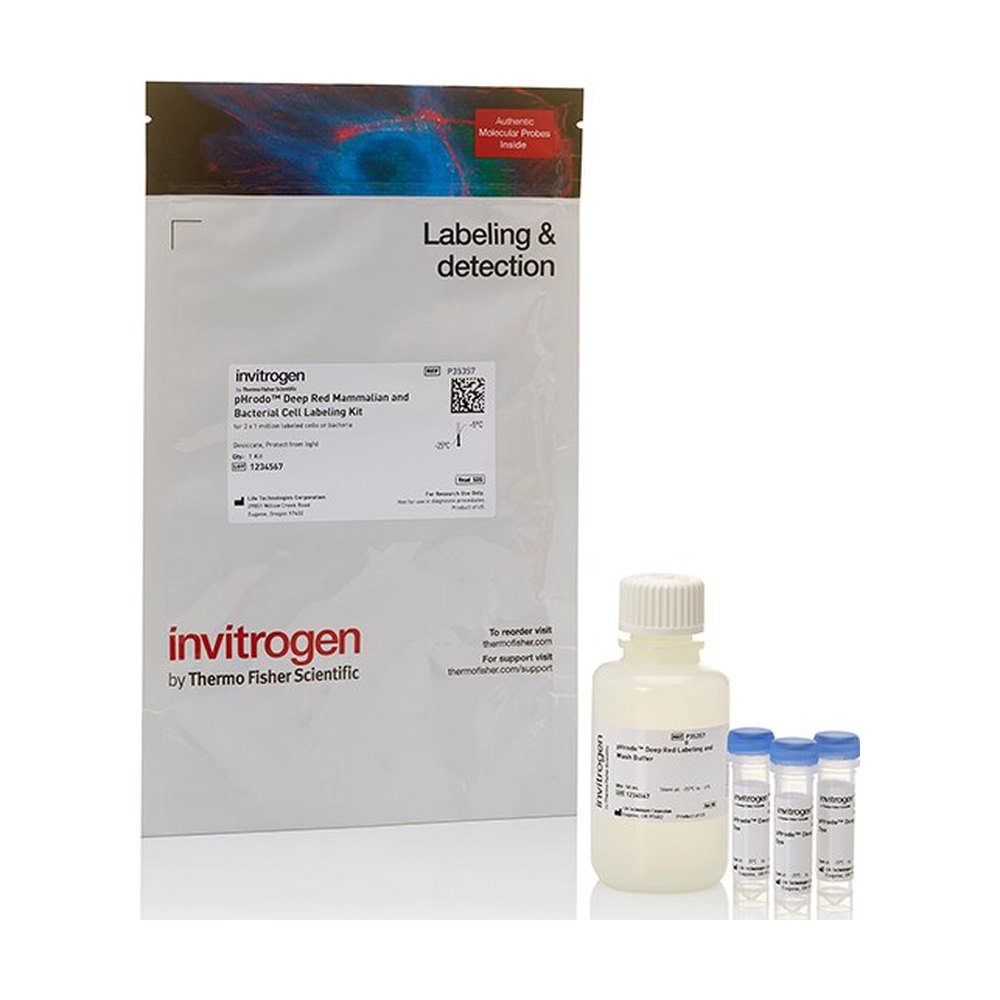
The pHrodo Deep Red Bacteria and Mammal Cell Marking Kit provides the reagents necessary to easily mark living cells (from mammals or bacteria) for the study of phagocytosis and lsendocytosis. It is optimized for the discrimination of phagocytotic and non-phagocytotic cells, as pHrodo Deep Red colouring is pH-sensitive and low-bottom-sensitive and has no signal under neutral conditions and is fluorescent only when exposed to acidic environments. This unique pHrodo Deep Red property allows rapid development of assays and reliability of results during the study of the endocytic and phagocytic pathways. The pHrodo Deep Red dye offers better discrimination of internal loading from outside the cell, as it has an approximate pKa of 5 and is not fluorescent until it has entered the last endosome and lysosome. The pHrodo Deep Red dye can be detected using a set of Cy5 fluorescent filters and has been validated for use in a variety of applications, including flow cytometry, fluorescence microscopy and high density analysis (HCA).
The pHrodo Deep Red Bacteria and Mammal Cell Marking Kit offers the following benefits:
• Multiplexing—The pHrodo Deep Red dye can be multiplexed with a wide variety of blue, green and red colorators and rapporteurs such as GFP and RFP, Mitosox Green or Red, CellEvent Caspase 3/7 Green or Red, NucBlue, or TMR, among others
• Simplicity—step by step protocol easy to follow
• Upper signalling window—the minimum background at a neutral pH allows maximum signal to noise ratio for reliable results
• Low pKa—elimines the non-specific signal of the non-internalized load and is fluorescent only in the last endosomes and lysosomes
Ordering information
Store in a refrigerator (2 – 8°C), dry, in order to protect from light, do not freeze.