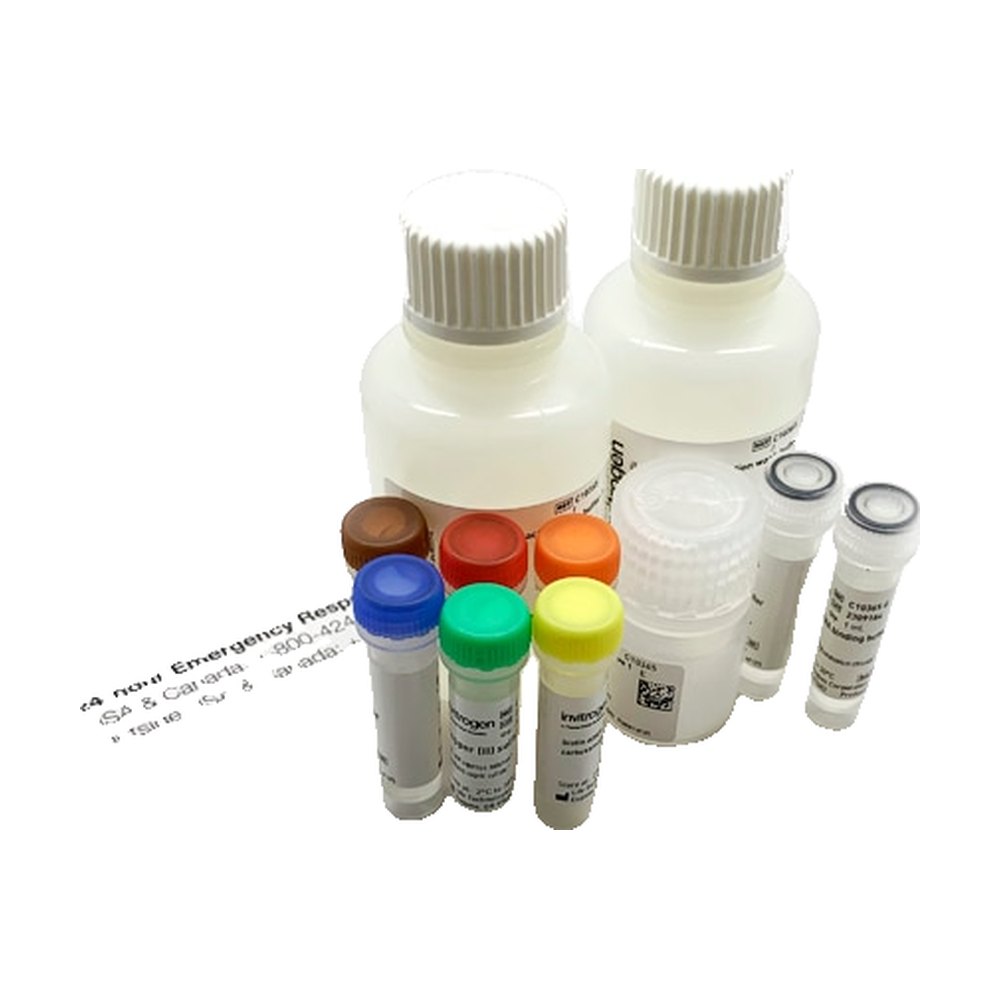
Quickly and easily determine degradation of the RNA with the IQ dosing kit of the RNA Qubit and the IQ standards of the RNA Qubit. The integrity and quality information (IQ) of the RNA is evaluated using the two unique dyes of the RNA...
Quickly and easily determine degradation of the RNA with the IQ dosing kit of the RNA Qubit and the IQ standards of the RNA Qubit. The integrity and quality information (IQ) of the RNA is evaluated using the two unique dyes in the dosing kit: a dye that binds to the large RNA and/or highly structured RNA and a second dye that selectively binds to the small RNA and degraded RNA. Together, the dyes allow you to quickly assess the quality and integrity of your samples d
The Quality Integrity Test Kit (IQ) of the RNA Qubit provides a simple and fast method for verifying whether a sample of d-RNA has been degraded using a Qubit 4 or Qubit Flex fluorometer. The IQ RNA assay uses two unique dyes: one that binds to a large, intact and/or highly structured RNA (mRNA, tRNA, rRNA) and the other that selectively binds to a small and/or degraded RNA. Together, these dyes allow you to quickly assess the quality and integrity of the d的RNA sample.
To use them, simply add your samples to the IQ working solution of the RNA, then measure the signal on a Qubit 4 or Qubit Flex fluorometer. The results are presented in the form of a IQ number of the RNA (n IQ RNA) which indicates the integrity and quality of the sample of the RNA. The results are also displayed as a calculated percentage of small and large size RNA in the sample. The IQ number of the RNA is between 1 and 10, similar to other quality scores for the RNA, where a low value indicates that the sample is composed mainly of small-sized d-RNA and a high value indicates that it mainly includes a large-sized RNA or tertiary-structured RNA.
Other features of the Qubit IQ dosing kit include:
• The tertiary structure of the tRNA and 5S binds the large colorant of the RNA
• Accuracy even in the presence of salts, proteins, solvents and stabilizers of the RNA
• Signal stability for 1 hour
Chemical based on the solution in phase with electrophoresis
The IQ results of the RNA assay are well correlated with those of electrophoretic methods. The main difference between the IQ-based solution-based assay and conventional electrophoresis-based techniques is the time required to determine whether a sample d-RNA was degraded. Gels are considered easy to use, but their treatment takes time. Microfluidic methods take time to produce results and often involve lengthy sample preparation procedures. Gel or microfluidic electrophoresis is still recommended to obtain information on fragment size or distribution of sample sizes of the RNA sample.
Quantification standards d的RNA Qubit QI
The QI dosing standards of the RNA Qubit are designed for use with the QI dosing kit of the RNA Qubit. Sufficient quantities of small and large size and/or standard structured L-RNA are provided to generate a standard IQ curve for up to 500 samples. The IQ standards of the RNA are designed to measure the degradation of the RNA and are not interchangeable with the standards of other quantification assays of the RNA, including the dosing kits of the RNA Qubit HS, BR or XR.
• The IQ dosing kits from the RNA Qubit are designed to work on the Qubit 4 and Qubit Flex fluorometers
• The dosage is not designed for use with Qubit, Qubit 2.0 or Qubit 3 fluorometers
• For use with 0.5 ml clear fine-walled PCR tubes (Reference Q32856) for the Qubit 4 and 8 strips fluorometer of 200 µl tubes (Reference Q33252) for the Qubit Flex fluorometer