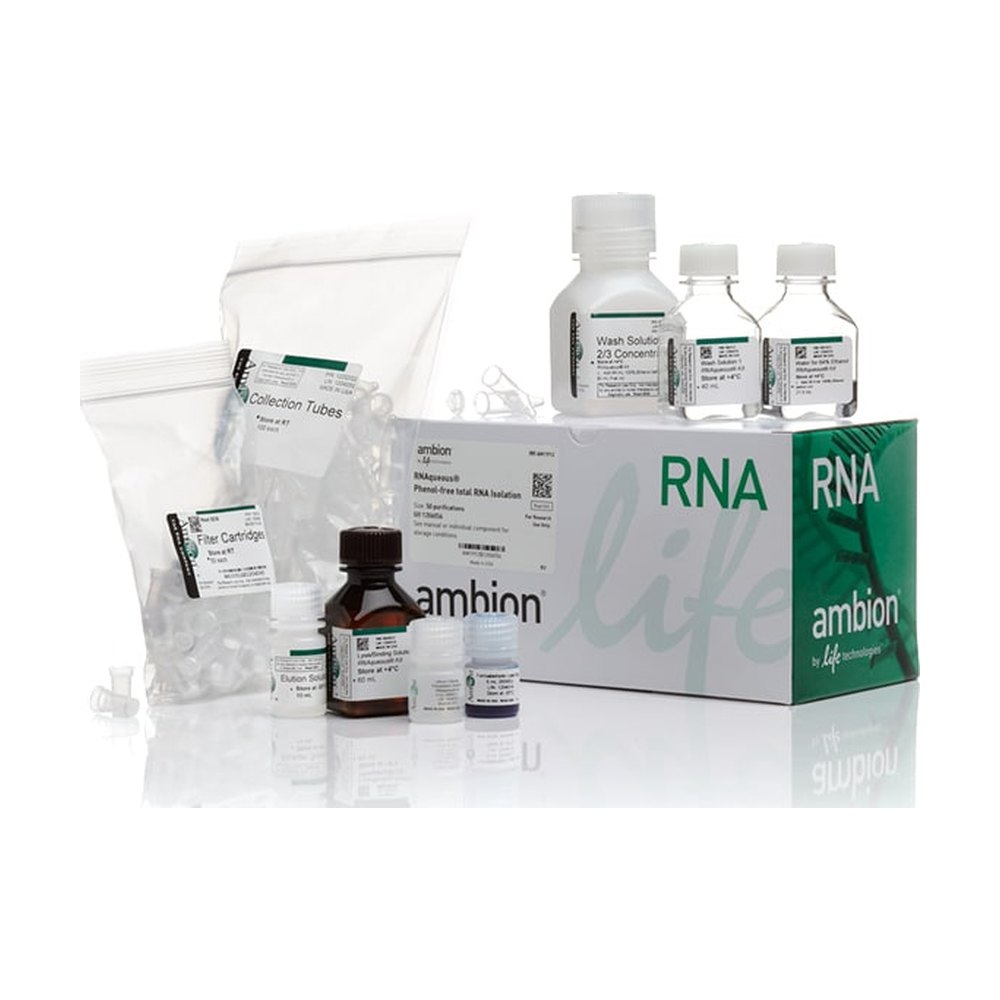
The Invitrogen PARIS™ system is intended for isolation of RNA and native proteins from the same experimental sample. The kit also allows the separation of nuclear and cytoplasmic fractions before isolation of the RNA and/or the...
The Invitrogen PARIS™ system is intended for isolation of RNA and native proteins from the same experimental sample. The kit also allows the separation of nuclear and cytoplasmic fractions before isolation of the RNA and/or proteins. The kit contains enough reagents for 50 purifications of 1 to 75 mg of tissue or 100 to 107 cells each.
The isolation of high quality RNA is the first step in a variety of genetic expression analyses. Very often additional protein studies are also needed. Generally, these analyses are performed using different aliquots from the same experimental sample. However, working with rare, difficult to obtain or very small samples sometimes makes it impractical to independently isolate the RNA and native proteins. In studies involving a large number of samples, expensive reagents or inherent variability (e.g., cell transfection), the addition of independent experimental samples is not only costly and time-consuming, but may also lead to inconsistent results. The protein isolation system and the RNA (PARIS system) was developed to solve these problems. It allows isolation of the RNA and proteins from the same experimental sample. Thanks to the PARIS system, both the RNA and the proteins can be isolated simultaneously from whole cell lysates. Otherwise, both the RNA and proteins can also be isolated from distinct nuclear and cytoplasmic fractions. The tissues or cells grown are first homogenized in a cold cell disturbance buffer to prepare a total cell lysate. Since L-homogenization is carried out rapidly on ice and in the presence of detergent, the protein and l-RNA can be purified directly from this lysate. For isolation of the RNA, part of the total cell lysate is immediately mixed with an equal volume of lysis/liaison solution. The total L-RNA is then purified from the mixture using a binding glass fibre filter at the RNA. After three quick washing steps, the high quality RNA is elected in a concentrated form. This procedure can be completed in less than 20 minutes. Note: This kit is not recommended for tissues with high ribonuclease levels, such as pancreas.
Compatible with most downstream applications of the PARIS process isolated from total, nuclear or cytoplasmic fractions can be used in various downstream applications, including transfer hybridization, in vitro translation, cDNA synthesis and RT-PCR. DNase I treatment is recommended for the RNA which will be used for real-time PCR experiments. Protein fractions can be used directly for most common applications, including functional assays, immunoprecipitation, Western blotting or two-dimensional gel electrophoresis.
Accessories: DNase TURBO DNA-free™ or DNA-free treatment and disposal reagents (catalogue No. AM1907 and AM1906, respectively) are ideal for the rapid removal of traces of DNA from the total and nuclear samples of the d-RNA without phenol extraction or alcohol precipitation. The cytoplasmic fraction d的RNA is practically free from contamination by l的DNA.
Not high-throughput compatible (manual)
Analysis and purification of cell lysis, DNA and RNA, protein preparation and protein purification, protein, expression, isolation and analysis, extraction of RNA, purification of specialized nucleic acids (e.g. total nucleic acids), total isolation of RNA, total RNA of animal cells and tissues
Ordering information
Shipping conditions: Ambient temperature
Simple and fast procedure
Simple and fast procedure
Isolate the RNA and nuclear proteins and...
Insulate the RNA and the nuclear and cytoplasmic proteins of the cultivated cells
Isolate total RNA and cell proteins...
Isolate total RNA and proteins from cells or tissues grown
No phenol extraction or precipitation...
No phenol extraction or alcohol precipitation
Reduces time, cost and variability between...
Reduces time, cost and variability between independent experimental samples
Technical specifications
| General |
|---|
| Brand | Invitrogen |
|---|
| Supplier ref. (Fisher Scientific) | 10404794 |
|---|
| Specifications |
|---|
| Isolation Technology | Cell lyse (non-ionic detergent) |
|---|
| Purification time | 20 min |
|---|
| Type of sample | Cell cultures, tissues (mammal), tissues (mammal) |
|---|
| End product type | Total RNA, proteins (native) (nuclear and cytoplasmic fractions), total RNA (nuclear and cytoplasmic fractions), proteins (native) |
|---|
| High-throughput compatibility | Not high-throughput compatible (manual) |
|---|
| For use with (application) | Real-time quantitative PCR (qPCR), reverse transcriptase PCR (RT-PCR), Western transfer, in vitro transcription, Northern transfer, library construction d |
|---|
| Quantity | 50 Preps |
|---|
| Quantity of start-up equipment | Up to 10^7 cells, up to 75 mg of tissue |
|---|
| Yield | ≤1 μg per 105 Cells
≤10 μg per 1 mg tissue |
|---|
| Physical characteristics |
|---|
| Volume of discharge | 50 to 200 μL |
|---|
| Storage and shipping |
|---|
| Content and storage | Keep cell disturbance buffer, cell fractionation buffer, 2X ⁄ lysis binding solution, wash solution 1, 2⁄3 wash solution concentrate and lithium chloride precipitation solution at 4°C. Keep filter cartridges, tubes and |
|---|
| Shipping conditions | Ambient temperature |
|---|
Origin and customs
| Manufacturer ref. | AM1921 |
|---|
| Country of origin | Lituanie |
|---|
| HS customs code | 3822 90 00 00 |
|---|
A question or a specific configuration?
Contact us for a quote.