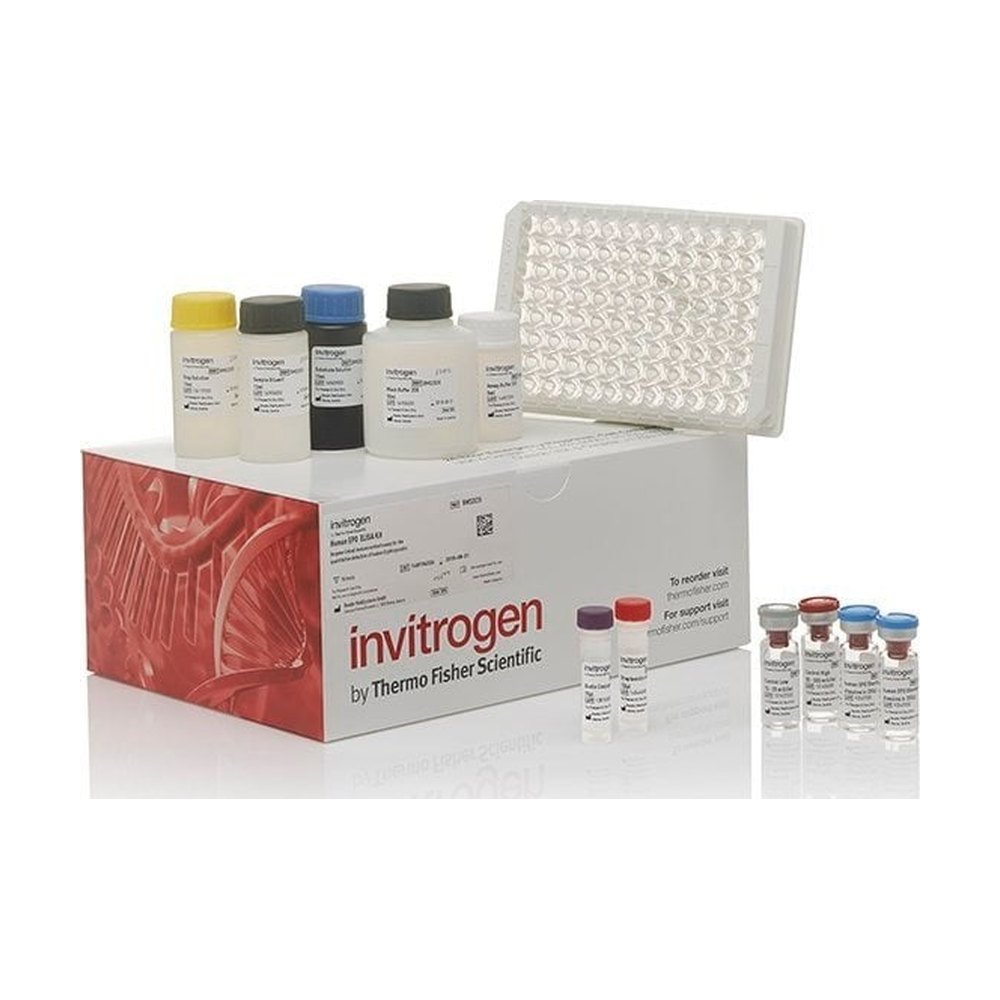
Ref.: BL-RE-095798Manufacturer ref.: BMS606-2TEN 10 x 96 tests
€4,780.00 excl. VAT
Kit ELISA IFN gamma sandwich (mouse): quantitative dosage of IFN gamma in serum, plasma, buffered solution or cell culture medium. The test recognizes only the natural and recombinant forms of IFN gamma Mouse.
Kit ELISA IFN gamma sandwich (mouse): quantitative dosage of IFN gamma in serum, plasma, buffered solution or cell culture medium. The test recognizes only the natural and recombinant forms of IFN gamma Mouse.
Kit ELISA IFN gamma sandwich (mouse): quantitative dosage of IFN gamma in serum, plasma, buffered solution or cell culture medium. The test recognizes only the natural and recombinant forms of IFN gamma Mouse.
Method principle: This ELISA solid phase sandwich test (immuno-enzymatic dose) measures the amount of target bound between a pair of matched antibodies. A specific target antibody is pre-adsorbed into the wells of the supplied microplate. Samples, standards or controls are added to these wells and bind to immobilized antibodies (capture antibodies). The sandwich is formed by adding the second antibody (detection antibody), then a substrate solution reacts with the enzyme-antibodies-target complex to produce a measurable signal. The intensity of this signal is directly proportional to the concentration of the target present in the original sample.
Rigorous validation: Each batch manufactured from this ELISA kit is checked for criteria such as sensitivity, specificity, accuracy and reproducibility from one batch to another (see the package leaflet for more information on validation).
The gamma IFN (Gamma Interferon, Interferon Type II) is a macrophage activation factor and immune interferon produced primarily by T cells and natural killer cells in response to antigens, mitogens, enterotoxins B of staphylococcus, phytohemaglutanin and other cytokines. The gamma IFN is a dimer protein composed of two subunits of 146 amino acids. The gamma IFN is a glycoprotein that exists, functionally, as a homodomer of about kDa. On SDS-PAGE, gamma IFN appears as a combination of , and minor kDa bands following differential glycosylation. The biological activity of gamma IFN homodomer is very species-specific. Human gamma IFN does not show cross-reactivity with mice. The function of gamma IFN includes antiviral activity, tumour antiproliferative activity, induction of class I and II MHC, activation of macrophages, and increase of secretion of immunoglobulins by B lymphocytes. The gamma IFN is involved in the regulation of cytokines and also acts in synergy with other cytokines. The activation of gamma IFN is achieved by binding of gamma I and II IFN receptors and by activation of the JAK-STAT pathway. The gamma IFN shows no homology with IFN alpha or IFN beta, but the human gamma IFN shows about 40% sequence homology with IFN gamma mouse. The gamma IFN is overregulated by the LIL, basic FGF, EGF and sub-regulated by vitamin D or DMN. The mutations of the gamma IFN gene are associated with aplastic anemia.
Sensitivity
Sensitivity of the dosage: 1.7 pg/mL.
Measurement range
Dose range: 15.6 to 1000 pg/mL.
Duration of dosing
Total duration of dosing: 3 h 10 min.
Target
Target: IFN gamma.
Samples
Type of sample: Plasma, Serum, Surnatant (surnatant volume, 50 µl; plasma, 50 µl; serum, 50 µl).