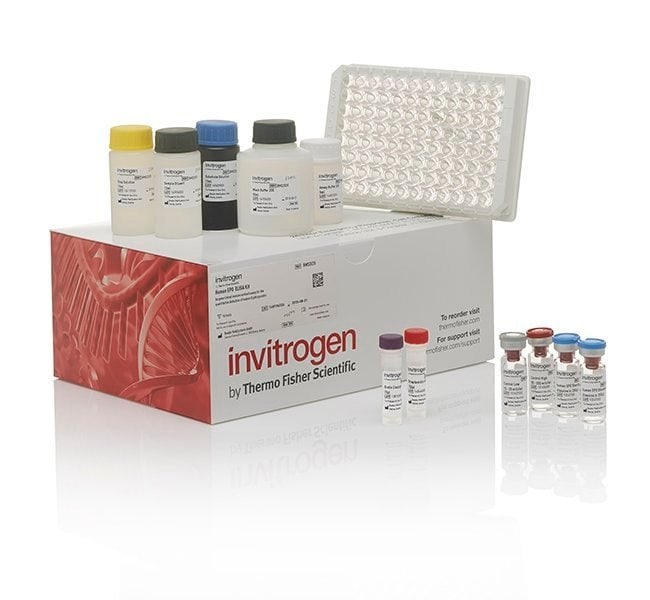
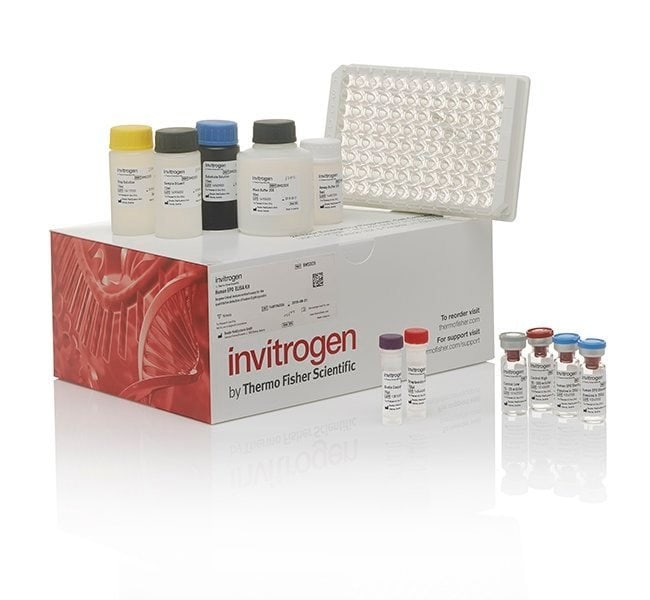
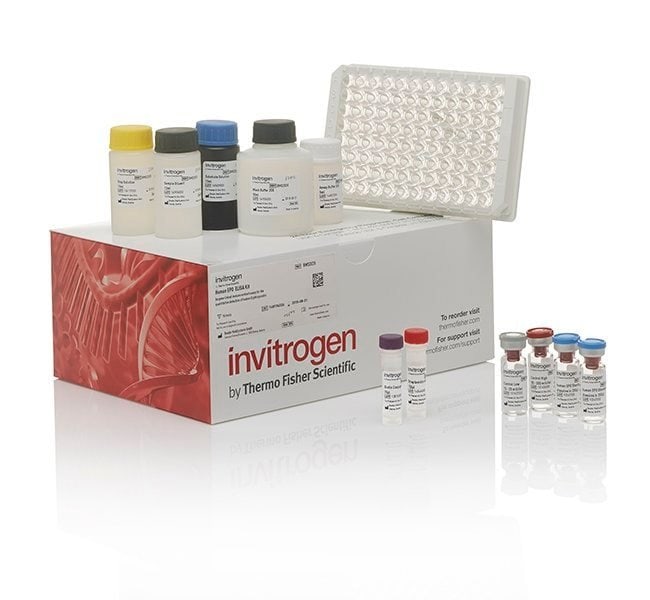
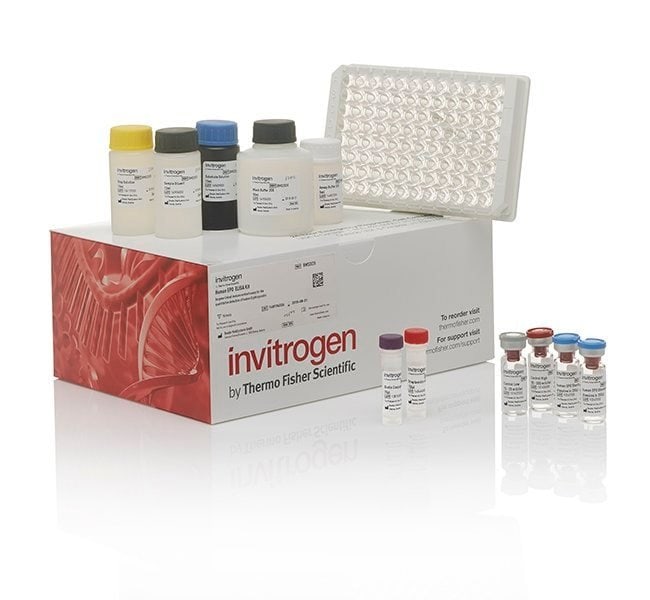
The Human Estrone-3 Sulfate (E1S) ELISA quantitates human estrone-3 Sulfate in human serum,plasma,urine,dried fecal extracts or cell culture medium.
Points forts
Principle of the method
The Estrone-3-Sulfate (E1S) Competitive ELISA research-use-only kit uses a specifically generated antibody to measure Estrone-3-Sulfate (E1S) in a variety of matrices,including serum,plasma,urine,and fecal samples. The kit will quantitatively measure E1S present in diluted buffer samples and tissue culture media samples. An E1S standard is provided to generate a standard curve for the assay and all samples should be read off the standard curve. Standards or diluted samples are pipetted into a clear microtiter plate coated with an antibody to capture rabbit antibodies. An E1S-peroxidase conjugate is added to the standards and samples in the wells. The binding reaction is initiated by the addition of a polyclonal antibody to E1S to each well. After a 2-hour incubation the plate is washed and substrate is added. The substrate reacts with the bound E1S-peroxidase conjugate. After a short incubation,the reaction is stopped and the intensity of the generated color is detected in a microtiter plate reader capable of measuring at 450 nm.
Rigorous validation
Each manufactured lot of this ELISA kit is quality tested for criteria such as sensitivity,specificity,precision,and lot-to-lot consistency. See manual for more information on validation.
Estrone-3-sulfate (1, 3, 5(10)-Estratrien-3-ol-17-one sulfate (E1S) is synthesized in the fetal or cotyledonary portion of the placentome. Estrone sulfate, present in plasma in a higher concentration than either unconjugated estrone or estradiol in nonpregnant women and normal men, appears to originate almost entirely from a conjugation of estrone and converted estradiolin nonglandular tissues. Estrone sulfate is only slowly cleared from plasma, thus its concentration does not fluctuate markedly during the day. Estrone sulfate is quantitatively the most important circulating estrogen. Estrone-3-sulfate (E1S) is identical across all species and so this kit should measure estrone-3-sulfate from all sources.
Caractéristiques techniques
| Marque | Invitrogen |
|---|
| Réf. B-LABO | BL-RE-106274 |
|---|
| Réf. fabricant | 17865307 |
|---|
| Plage de dosage | 40,96-4000 pg/ml |
|---|
| Sensibilité du dosage | 26,4 pg/ml |
|---|
| Doser | Dosage multiplex sur la plateforme Luminex |
|---|
| Conjugué | HRP |
|---|
| Méthode de détection | Fluorescent |
|---|
| Type de produit | Kit ELISA |
|---|
| Type d’échantillon | Extrait fécal, Sérum, Surnageant, Surnageant, Urine |
|---|
| Suffisant pour | 10 x 96 dosages |
|---|
| Espèces cibles | Humaine |
|---|
| À utiliser avec (application) | ELISA, dosages de protéines, tests d’activité, biologie des protéines, biologie de la reproduction, inflammation, stress oxydatif, métabolisme, signalisation cellulaire, épigénétique, hématologie, dommages à l’ADN, biologie du cancer, immunologie, neurosciences, neurobiologie, détection d’hormones stéroïdes |
|---|
| À utiliser avec (équipement) | Lecteur de microplaques colorimétriques |
|---|
| Coefficient de variation inter-dosage | 8,5% |
|---|
| Coefficient de variation intra-dosage | 4,2% |
|---|
| Contenus des kits | Plaque à 96 puits pré-enduite, Étalon, Concentrat de diluant de dosage, Anticorps de détection conjugué au HRP, Tampon de lavage, Chromogène, Solution d’arrêt, Couvercles de plaques adhésives |
|---|
| Marqueur ou colorant | HRP |
|---|
| État réglementaire | RUO |
|---|
| Disciplines de recherche | Biologie de la reproduction |
|---|
| Volume d’échantillon | Extrait fécal, 50 μl ; plasma, 1 μl ; sérum, 1 μl ; surnageant, 50 μl ; urine, 6,25 μl |
|---|
| Conditions de stockage | -20°C |
|---|
| Cible | Produits chimiques |
|---|
| Heure du test | 1 h 20 min |
|---|
| Durée totale du dosage | 2 h 30 min |
|---|
Une question, une configuration particulière ?
Contactez-nous pour un devis.