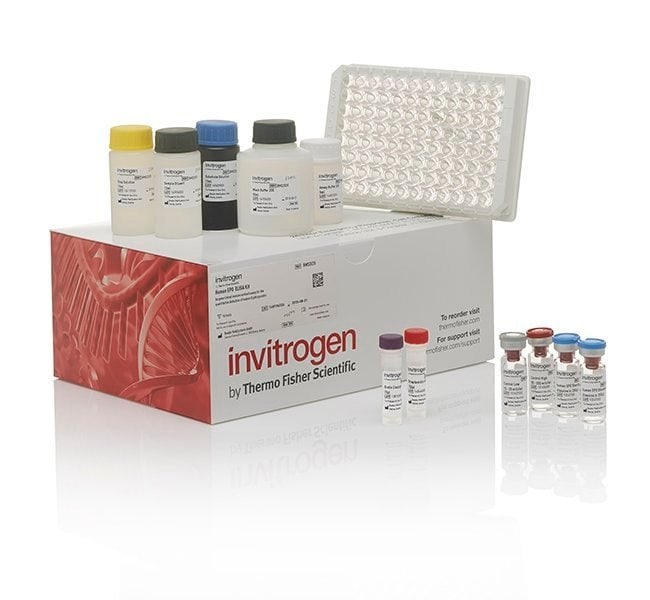
The Human IL1RL1/ST2 ELISA quantitates Hu IL1RL1 in human serum, plasma, buffered solution, or cell culture medium. The assay will exclusively recognize both natural and recombinant Hu IL1RL1. Principle of the method The Human IL1RL1 solid-phase sandwich ELISA (enzyme-linked immunosorbent assay) is designed to measure the amount of the target bound between a matched antibody pair. A target-specific antibody has been pre-coated in the wells of the supplied microplate. Samples, standards, or controls are then added into these wells and bind to the immobilized (capture) antibody. The sandwich is formed by the addition of the second (detector) antibody, a substrate solution is added that reacts with the enzyme-antibody-target complex to produce measurable signal. The intensity of this signal is directly proportional to the concentration of target present in the original specimen. Rigorous validation Each manufactured lot of this ELISA kit is quality tested for criteria such as sensitivity, specificity, precision, and lot-to-lot consistency. See manual for more information on validation.
ST2 is a member of the interleukin 1 receptor family. Studies of ST2 in mouse suggested that this receptor can be induced by proinflammatory stimuli, and may be involved in the function of helper T cells. ST2 belongs to the interleukin-1 receptor family with three Ig-like C2-type (immunoglobulin-like) domains and a TIR domain. ST2 is a receptor for interleukin-33 (IL-33) which upon stimulation recruits the signaling molecules MYD88, IRAK1, IRAK4, and TRAF6, followed by phosphorylation of MAPK3/ERK1 and/or MAPK1/ERK2, MAPK14, and MAPK8. Reports also suggest its possible role in helper T-cell function as well as in cell growth. Three isoforms of ST2 have been reported where isoform C is a membrane form and isoform B is a secreted form. ST2 may be induced by proinflammatory stimuli, and may also be found in serum of autoimmune disease. Different isoforms are restricted to different tissues while high expression of this protein is evident in kidney, lung, placenta, stomach, skeletal muscle, colon and small intestine.
Caractéristiques techniques
| Marque | Invitrogen |
|---|
| Réf. B-LABO | BL-RE-143675 |
|---|
| Réf. fabricant | 17895107 |
|---|
| Numéro d’adhésion | Q01638 |
|---|
| Plage de dosage | 31,25-2000 pg/ml |
|---|
| Sensibilité du dosage | 30,5 pg/ml |
|---|
| Doser | Dosage multiplex sur la plateforme Luminex |
|---|
| Conjugué | Biotine |
|---|
| Méthode de détection | Fluorescent |
|---|
| Type de produit | Kit ELISA |
|---|
| Type d’échantillon | Sérum, Surnageant, Surnageant |
|---|
| Suffisant pour | 10 x 96 dosages |
|---|
| Espèces cibles | Humaine |
|---|
| À utiliser avec (application) | ELISA, dosages de protéines, tests d’activité, biologie des protéines, biologie de la reproduction, inflammation, stress oxydatif, métabolisme, signalisation cellulaire, épigénétique, hématologie, dommages à l’ADN, biologie du cancer, immunologie, neurosciences, neurobiologie, détection d’hormones stéroïdes |
|---|
| À utiliser avec (équipement) | Lecteur de microplaques colorimétriques |
|---|
| Identification génétique (Entrez) | 9173 |
|---|
| Symbole de gène(s) | IL1RL1 |
|---|
| Coefficient de variation inter-dosage | 8,5% |
|---|
| Coefficient de variation intra-dosage | 4,3% |
|---|
| Contenus des kits | Plaque à 96 puits pré-enduite, Étalon, Concentrat de diluant de dosage, Anticorps de détection biotinylé, Tampon de lavage, Chromogène, Solution d’arrêt, Couvercles de plaques adhésives, Couvercles de plaques adhésives |
|---|
| Marqueur ou colorant | HRP |
|---|
| État réglementaire | RUO |
|---|
| Disciplines de recherche | Inflammation |
|---|
| Volume d’échantillon | Plasma, 12,5 μl ; sérum, 12,5 μl ; surnageant, 50 μl |
|---|
| Conditions de stockage | -20°C |
|---|
| Cible | Humaine |
|---|
| Heure du test | 1 h 20 min |
|---|
| Durée totale du dosage | 3 h |
|---|
Une question, une configuration particulière ?
Contactez-nous pour un devis.