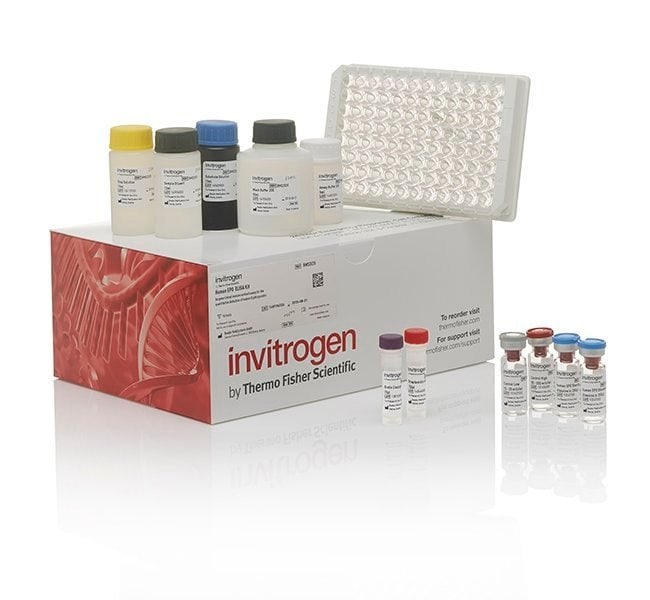
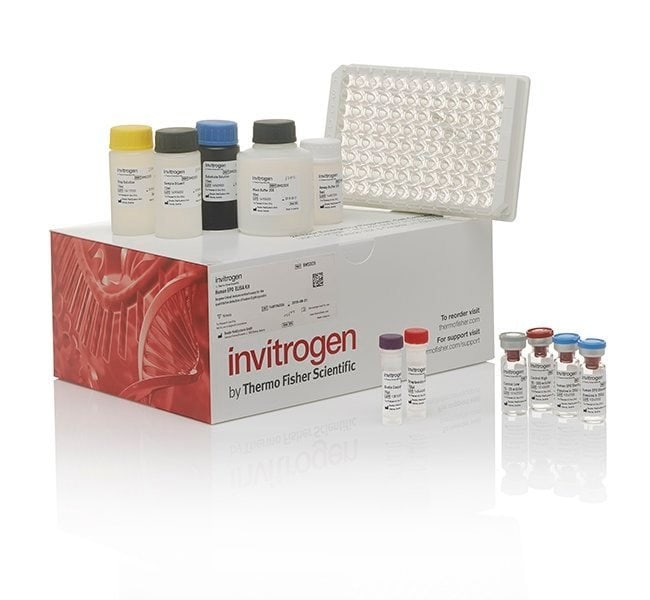
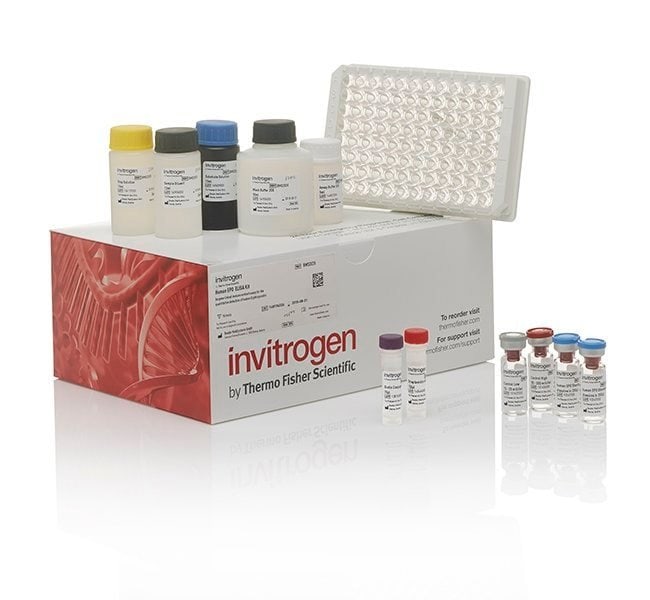
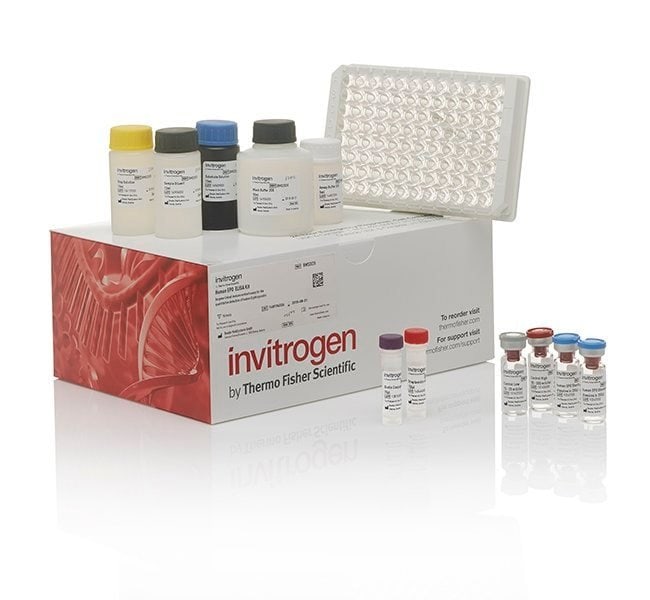
The PGFM Enzyme ELISA quantitates PGFM in serum,plasma,urine,dried fecal extracts,or cell culture medium.
Points forts
Principle of the method
The PGFM Competitive ELISA research-use-only kit designed to quantitatively measure PGFM present in fecal extracts,urine,serum,and plasma samples. A PGFM standard is provided to generate a standard curve for the assay and all samples should be read off the standard curve. Standards or diluted samples are pipetted into a clear microtiter plate coated with an antibody to capture rabbit IgG. A PGFM-peroxidase conjugate is added to the standards and samples in the wells. The binding reaction is initiated by the addition of a rabbit polyclonal antibody highly specific to PGFM to each well. After a 1-hour incubation,the plate is washed and substrate is added. The substrate reacts with the bound PGFM-peroxidase conjugate. After a short incubation,the reaction is stopped and the intensity of the generated color is detected in a microtiter plate reader capable of measuring at 450 nm.
Rigorous validation
Each manufactured lot of this ELISA kit is quality tested for criteria such as sensitivity,specificity,precision,and lot-to-lot consistency. See manual for more information on validation.
In many species, uterine and placental Prostaglandin F2alpha (PGFM) is involved in the regulation of reproductive and pregnancy-related processes such as embryonic development, initiation of parturition, and resumption of ovarian activity. Prostaglandin F2alpha is metabolized to PGFM during the first passage through the lungs. PGFM has a longer half-life in peripheral circulation than PGF2alpha and has been applied as a useful analytical marker of PGF2alpha. PGFM is identical across all species and so this kit should measure PGFM from sources other than those tested.
Caractéristiques techniques
| Marque | Invitrogen |
|---|
| Réf. B-LABO | BL-RE-162030 |
|---|
| Réf. fabricant | 17825017 |
|---|
| Plage de dosage | 50-3200 pg/ml |
|---|
| Sensibilité du dosage | 20,8 pg/ml |
|---|
| Doser | Dosage multiplex sur la plateforme Luminex |
|---|
| Conjugué | HRP |
|---|
| Méthode de détection | Fluorescent |
|---|
| Type de produit | Kit ELISA |
|---|
| Type d’échantillon | Extrait fécal, Sérum, Surnageant, Surnageant, Urine |
|---|
| Suffisant pour | 10 x 96 dosages |
|---|
| Espèces cibles | Humaine |
|---|
| À utiliser avec (application) | ELISA, dosages de protéines, tests d’activité, biologie des protéines, biologie de la reproduction, inflammation, stress oxydatif, métabolisme, signalisation cellulaire, épigénétique, hématologie, dommages à l’ADN, biologie du cancer, immunologie, neurosciences, neurobiologie, détection d’hormones stéroïdes |
|---|
| À utiliser avec (équipement) | Lecteur de microplaques colorimétriques |
|---|
| Coefficient de variation inter-dosage | 9,7% |
|---|
| Coefficient de variation intra-dosage | 9,2% |
|---|
| Contenus des kits | Plaque à 96 puits pré-enduite, Étalon, Concentrat de diluant de dosage, Anticorps de détection conjugué au HRP, Tampon de lavage, Chromogène, Solution d’arrêt, Couvercles de plaques adhésives |
|---|
| Marqueur ou colorant | HRP |
|---|
| État réglementaire | RUO |
|---|
| Disciplines de recherche | Biologie de la reproduction |
|---|
| Volume d’échantillon | Extrait fécal, 50 μl ; plasma, 6,25 μl ; sérum, 6,25 μl ; surnageant, 50 μl ; urine, 6,25 μl |
|---|
| Conditions de stockage | -20°C |
|---|
| Cible | Produits chimiques |
|---|
| Heure du test | 1 h 20 min |
|---|
| Durée totale du dosage | 1 h 30 min |
|---|
Une question, une configuration particulière ?
Contactez-nous pour un devis.