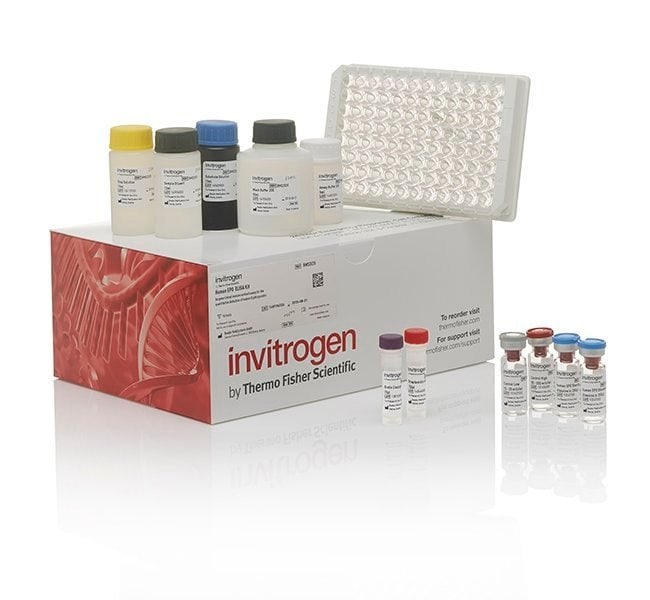
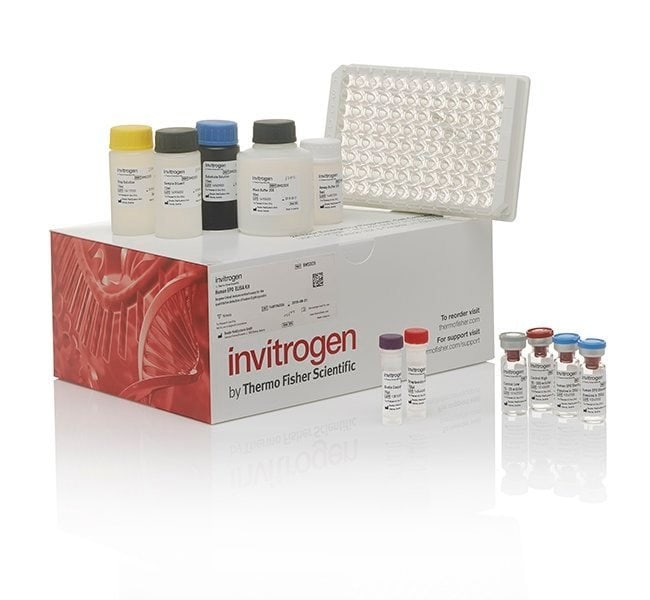
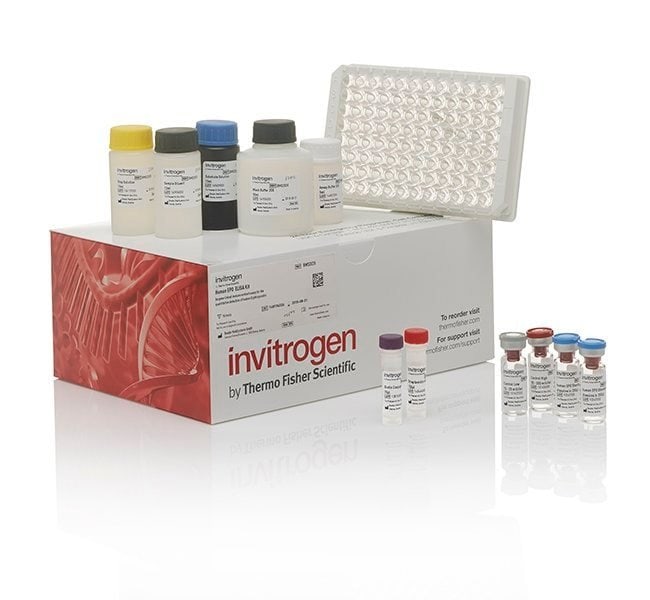
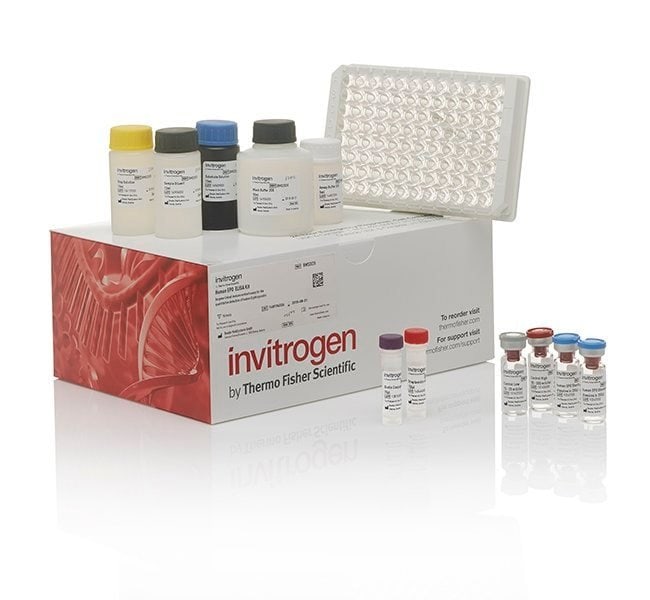
The Progesterone ELISA quantitates progesterone in urine,dried fecal extracts or cell culture medium.
Points forts
Principle of the method
The Progesterone Competitive ELISA research-use-only kit is designed to quantitatively measure Progesterone present in extracted dried fecal samples,urine,and tissue culture media samples. A progesterone standard is provided to generate a standard curve for the assay and all samples should be read off the standard curve. Standards or diluted samples are pipetted into a clear microtiter plate coated with an antibody to capture mouse antibodies. A progesterone-peroxidase conjugate is added to the standards and samples in the wells. The binding reaction is initiated by the addition of a monoclonal antibody to progesterone to each well. After a 2-hour incubation the plate is washed and substrate is added. The substrate reacts with the bound progesterone-peroxidase conjugate. After a short incubation,the reaction is stopped and the intensity of the generated color is detected in a microtiter plate reader capable of measuring at 450 nm.
Rigorous validation
Each manufactured lot of this ELISA kit is quality tested for criteria such as sensitivity,specificity,precision,and lot-to-lot consistency. See manual for more information on validation.
Progesterone is the major progestational steroid, secreted primarily by the corpus luteum and the placenta. Progesterone binds to the progesterone receptor, resulting in dissociation of heat shock proteins, receptor phosphorylation, and transcription activation through direct or indirect interaction with transcription factors. Progesterone acts on the uterus, the mammary glands and the brain. It is required in embryo implantation, pregnancy maintenance, and the development of mammary tissue for milk production. Progesterone, converted from pregnenolone, also serves as an intermediate in the biosynthesis of gonadal steroid hormones and adrenal corticosteroids. Therapeutic progesterone is a synthetic form of the endogenous hormone progesterone. This agent exerts inhibitory effects on estrogens by decreasing the number of estrogen receptors and increasing its metabolism to inactive metabolites. [National Center for Biotechnology Information. PubChem Compound Database; CID=5994].
Caractéristiques techniques
| Marque | Invitrogen |
|---|
| Réf. B-LABO | BL-RE-090441 |
|---|
| Réf. fabricant | 17835217 |
|---|
| Plage de dosage | 50-3200 pg/ml |
|---|
| Sensibilité du dosage | 47,9 pg/ml |
|---|
| Doser | Dosage multiplex sur la plateforme Luminex |
|---|
| Conjugué | HRP |
|---|
| Méthode de détection | Fluorescent |
|---|
| Type de produit | Kit ELISA |
|---|
| Type d’échantillon | Extraits fécaux, surnageant, Surnageant |
|---|
| Suffisant pour | 10 x 96 dosages |
|---|
| Espèces cibles | Humaine |
|---|
| À utiliser avec (application) | ELISA, dosages de protéines, tests d’activité, biologie des protéines, biologie de la reproduction, inflammation, stress oxydatif, métabolisme, signalisation cellulaire, épigénétique, hématologie, dommages à l’ADN, biologie du cancer, immunologie, neurosciences, neurobiologie, détection d’hormones stéroïdes |
|---|
| À utiliser avec (équipement) | Lecteur de microplaques colorimétriques |
|---|
| Coefficient de variation inter-dosage | 5,7% |
|---|
| Coefficient de variation intra-dosage | 3,9% |
|---|
| Contenus des kits | Plaque à 96 puits pré-enduite, Étalon, Concentrat de diluant de dosage, Anticorps de détection conjugué au HRP, Tampon de lavage, Chromogène, Solution d’arrêt, Couvercles de plaques adhésives |
|---|
| Marqueur ou colorant | HRP |
|---|
| État réglementaire | RUO |
|---|
| Disciplines de recherche | Biologie de la reproduction |
|---|
| Volume d’échantillon | Extrait fécal, 50 μl ; surnageant, 50 μl ; urine, 12,5 μl |
|---|
| Conditions de stockage | -20°C |
|---|
| Cible | Produits chimiques |
|---|
| Heure du test | 1 h 20 min |
|---|
| Durée totale du dosage | 2 h 30 min |
|---|
Une question, une configuration particulière ?
Contactez-nous pour un devis.