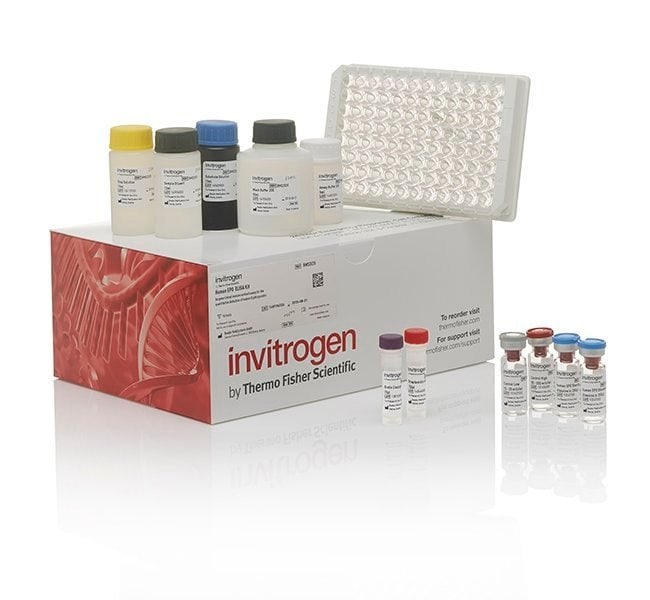
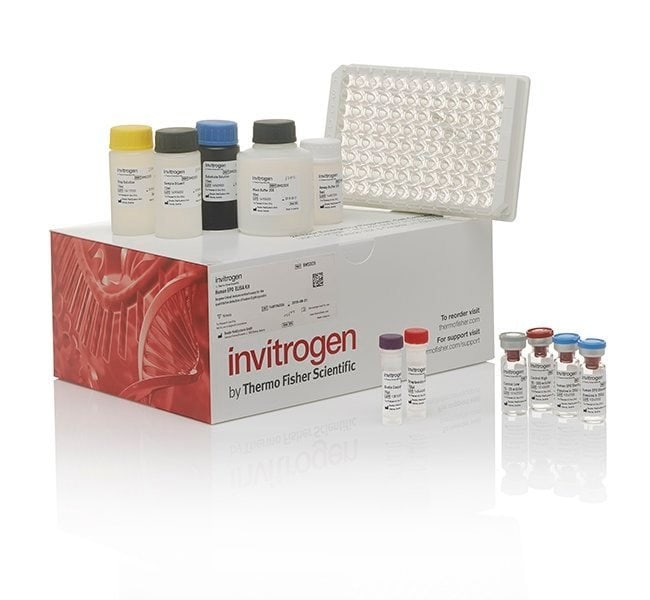
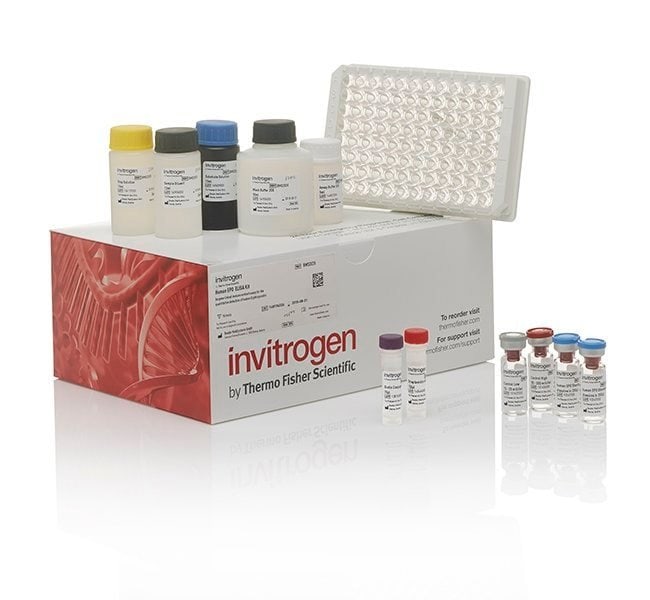
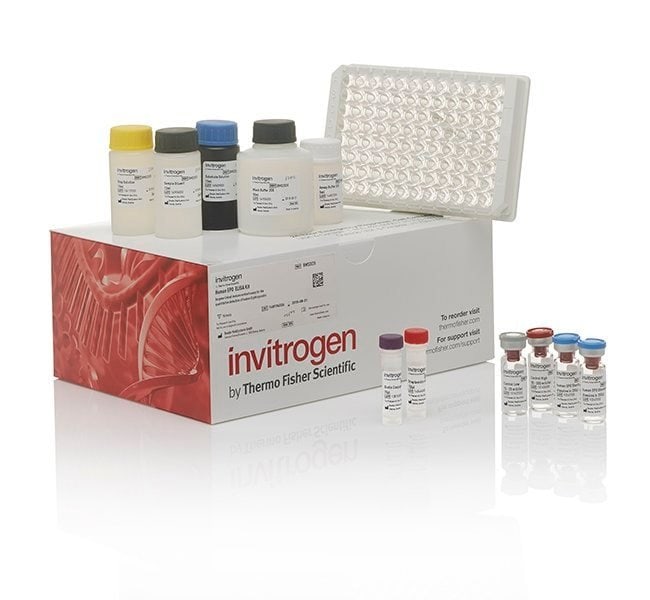
Kit is designed to detect and quantify the level of IRS1 (Phospho) [pS312] in fresh or frozen human cell lysates. Cross-reactivity has been observed in mouse and rat cells. The assay recognizes both natural and recombinant IRS1 (Phospho) [pS312]. Principle of the method A monoclonal capture antibody specific for IRS1 (Phospho) [pS312] has been coated onto the wells of the 96-well plate. During the first incubation, standards of known content and unknown samples are pipetted into the wells and the antigen binds to the immobilized (capture) antibody. After washing, a rabbit antibody specific for the target protein is added to the wells and serves as a detection antibody by binding to the immobilized protein captured during the first incubation. After washing, a horseradish peroxidase labeled anti-rabbit IgG is added. This binds to the detection antibody to complete the four member sandwich. After a third incubation and washing to remove all the unbound enzyme, a substrate solution (TMB) is added, which is acted upon by the bound enzyme to produce color. The intensity of this colored product is directly proportional to the concentration of target protein present in the original specimen and the optical density can be read on a standard microplate reader. Rigorous validation Each manufactured lot of this ELISA kit is quality tested for criteria such as sensitivity, specificity, precision, and lot-to-lot consistency. See manual for more information on validation.
IRS-1, un substrat majeur du récepteur de l’insuline, est phosphorylé en réponse à la stimulation des cellules par l’insuline, le facteur de croissance analogue à l’insuline 1 (IGF-1) et l’interleukine 4 (IL-4). L’IRS-1 est phosphorylé sur des résidus de sérine, de thréonine et de tyrosine dans divers tissus. Une kinase de sérine / thréonine sensible à l’insuline caséine kinase II médie une partie de la phosphorylation de la sérine / thréonine stimulée par l’insuline de l’IRS-1 in vivo surexprimée. Le Thr 502 est identifié comme le principal site de phosphorylation catalysée par la caséine kinase II dans l’IRS-1 de rat et le Ser 99 est un site de phosphorylation supplémentaire catalysé par la caséine kinase II. Ainsi, la phosphorylation catalysée par la caséine kinase II de l’IRS-1 peut être une composante de la cascade de signalisation de l’insuline intracellulaire. L’IRS-1 contient trois sites de liaison putatifs pour 14-3-3 (Ser 270, Ser 374 et Ser 641) et le motif autour de Ser 270 est situé dans le domaine de liaison phospho-tyrosine de l’IRS-1, qui est responsable de l’interaction avec le récepteur d’insuline.
Points forts
Informations sur la commande
Conditions d’expédition : Glace humide
Caractéristiques techniques
| Marque | Invitrogen |
|---|
| Réf. B-LABO | BL-RE-092757 |
|---|
| Réf. fabricant | 10374633 |
|---|
| Numéro d’adhésion | P35568, P35569, P35570 |
|---|
| Plage de dosage | 1,6-100 U/ml |
|---|
| Sensibilité du dosage | < 1 U/mL |
|---|
| Concentration | 1,6 U/ml |
|---|
| Conjugué | HRP |
|---|
| Type de produit | Kit ELISA |
|---|
| Type d’échantillon | Lysats cellulaires |
|---|
| Type de substrat | Protéines adaptatrices |
|---|
| Espèces cibles | Souris, rat |
|---|
| À utiliser avec (équipement) | Lecteur de microplaques colorimétriques |
|---|
| Identification génétique (Entrez) | 16367, 25467, 3667 |
|---|
| Symbole de gène(s) | HIRS-1 |
|---|
| Temps d’incubation | 4 h |
|---|
| Coefficient de variation inter-dosage | 7,4% |
|---|
| Coefficient de variation intra-dosage | 5,8% |
|---|
| Contenus des kits | Plaque à 96 puits pré-enduite, Étalon, Tampon de dilution standard, Détection d'anticorps, Anti-lapin HRP, Diluant HRP, Tampon de lavage, Chromogène, Solution d’arrêt, Couvercles de plaques adhésives |
|---|
| Marqueur ou colorant | HRP |
|---|
| Marqueur génétique | IRS-1 |
|---|
| Quantité | 96 tests |
|---|
| État réglementaire | RUO |
|---|
| Volume d’échantillon | Lysat cellulaire (,10 μl) |
|---|
| Conditions de stockage | 2°C à 8°C |
|---|
| Cible | Humain, souris et rat |
|---|
| Heure du test | 1 h 20 min |
|---|
| Durée totale du dosage | 4 h |
|---|
Une question, une configuration particulière ?
Contactez-nous pour un devis.